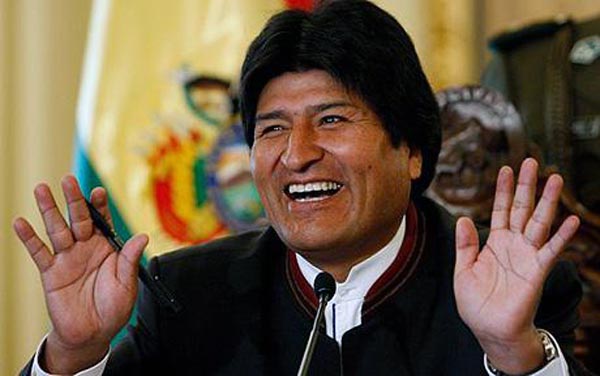
Throughout its fractious history, Bolivia has suffered from persistent social inequality and political instability, as well as an apparent inability to implement economic policies capable of securing long-term prosperity. Thus, it was on promises of social equality, economic parity, and sustainable growth that Evo Morales was swept into power in 2005 with a record tally of more than 50 percent of the vote. Morales touted “equality for the country’s historically marginalized and discriminated impoverished indigenous majority.”(1) However, he has largely failed to keep these promises, often finding it difficult to translate his charged rhetoric into viable policy and thus maintaining the status quo. Despite his original popularity, this reality could ultimately push him out of office in the 2014 elections, or even before, particularly if the current social unrest continues.
The Rise of Morales
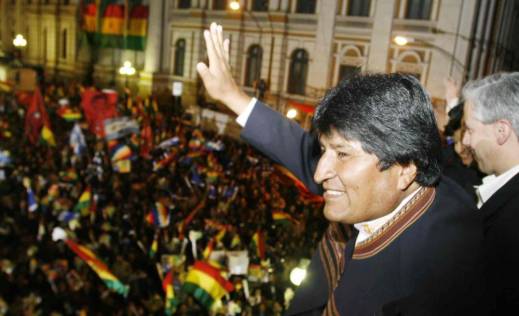
Morales’ reputation of struggling to end poverty greatly influenced his rise to power and his popularity. After losing four siblings to poverty, his family moved to the Chapare, a rural region in the Department of Cochabamba.(2) Early in his political career, Morales became involved with campesinos and coca growers, forming connections that influenced his rise to the presidency of the coca-leaf growers union and, later, to a seat as congressional representative in the Bolivian parliament. While then-Congressman Morales was attending an inter-parliamentary conference in Geneva, Switzerland, in October 2003, a massive uprising of Bolivian campesinos ousted President Sánchez de Lozada from power. A series of social movements and popular protests followed, destabilizing the neoliberal government and forcing the premature presidential election of late 2005.(3)
During the presidential campaigns, the indigenous Bolivian population, which comprises 62 percent of the population, widely identified with Morales because of his indigenous descent. They became his unconditional supporters and placed their hopes in him to change the country’s entrenched social divides in their favor.(4) Indeed, Morales’ victory in 2005 was a result of arguably one of the largest popular mobilizations of the indigenous observed in Latin America over the past decade.(5) Upon assuming the presidency, Morales appeared serious about answering his electoral mandate. He organized a national referendum to amend the nation’s Constitution, hoping to expand the indigenous population’s governmental representation as well as recover economic control of the country’s natural resources, such as natural gas, through a protracted nationalization process of foreign owned enterprises.
Morales Today
Even though Morales began his presidency with much vigor, once in office his administration did not necessarily yield the results coveted by his electorate. In Morales’ six years as president, he has targeted inequality in Bolivia but only to a limited extent. As his administration has been largely tied to charges of corruption, human rights violations, and censorship, critics of Morales argue that the issues of ethnic diversity and inequality have oftentimes consequently gone unaddressed. Indigenous leader Fernando Vargas, for instance, has leveled the vocal accusation that Morales continues to effectively colonize the indigenous population of Bolivia by not considering their opinions on issues of critical importance to them.(6)
In defending himself against such claims, Morales points to the upcoming referendum he initiated regarding the construction of a highway that would destroy part of TIPNIS national park, as evidence of his commitment to the inclusion of the indigenous in the decision-making process. Thus far the affected indigenous populations have expressed strong opposition to the project, protesting its shortcomings with a one-month-long march to La Paz. As of June 20, two protest marches composed of TIPNIS indigenous community members had been mounted to ask the government to cease the highway project. During these marches, at least five individuals died, half of them children. Many more have been affected by disease, accidents, and have been subjected to bodily harm in repeated aggression by the police forces Morales administration ordered to stymie the march. Rather than listening to the indigenous pleas, Vargas claims that the government has given engines, solar panels, energy generators, and more, to the people of TIPNIS as “gifts,” in an effort to gain support for the upcoming referendum. For Vargas such attempts to co-opt indigenous populations are eerily familiar: “I thought that the colonization of 500 years had ended, but it has become apparent that the colonization in Bolivia continues with President Evo Morales.”(7)
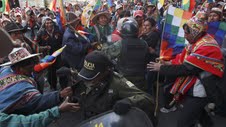
In response to continued construction on the highway project and the governments’ deaf blind eye to indigenous protests, a group of the indigenous met with José Miguel Insulza, general secretary of the Organization of American States, over the weekend of June 1. The meeting’s purpose was to inform Insulza of the violation of human rights and freedom of speech committed by the Bolivian government.(8) There, the group asked Insulza to mediate with La Paz on the issue.
The Sandinista Nicaraguan daily, El Nuevo Diario, reported this year that the social groups that had carried Morales to power in 2006 are now turning their backs on him for failing to uphold his campaign promises.(9) For example, members of the Bolivian Labor Union (Central Obrera Boliviana) argue that the Morales administration continuously does not listen to their demands, something Morales promised not to do when he assumed the presidency.
As a result of Morales’ sometimes-rash decision-making, conflicts in the departments of Chuquisaca, Pando, Potosí, and Santa Cruz have resulted in the deaths of Bolivian citizens. Eight months after Morales became president, violence in the Potosí mining community in Huanuni led to the deaths of 16 people during a dispute over local mining privileges. Many ensured that the confrontation could have been prevented if Morales had stayed loyal to the pledges he had made to the cooperativistas who had been extremely influential during his election.(10) Unfortunately for the masses of Bolivians who voted for Evo Morales, only few of them believe he has kept his electoral promises. As for the rest, they have noted how the government has spent time and resources on issues that have not solved their immediate problems, such as changing the national flag emblem. Due to Morales’ inability to formulate policies that reflect his progressive position, the opposition sees him as merely attacking them with the intention of getting vengeance for the oppression Morales and his people had suffered during the early years of his adult life.
For example, on May 28, for the first time in Bolivia’s democratic history, a senator sought asylum at the Brazilian embassy in La Paz. Senator Roger Pinto had claimed that he had no other option than to solicit asylum due to the “harassment and persecution [that he faced] from the government of Evo Morales.”(11) During Morales’ two terms in office, several other political foes have sought political asylum in the United States, Brazil, Paraguay, Peru and Spain due to alleged political prosecution.(12) Further depicting the extent to which the Morales administration has badgered the opposition, the Bolivian government refuses to procure the required documents that would allow Pinto to travel to Brazil. According to Pinto, the Foreign Minister of Bolivia David Choquehuanca once said in a meeting with ambassadors residing in the country, “If Brazil wants a thief and a corrupt man then it will take Roger Pinto, but he will stay until he rots in the [Brazilian] embassy.”(13)
Conclusion
Morales’ economic and social policies have been faulted for not adequately addressing the problems of ethnic inequality; instead, his supporters have seen the country’s divisive issues exacerbated. Consequently, his administration has been accused of following a path that is not beneficial for its people. The next Bolivian election is scheduled for the end of 2014, giving Morales time to become the leader he once promised to be. While doing so will be easier said than done, the Morales administration would do well to heed four pieces of advice. First, more resources should be diverted to benefit the Bolivian public education and health systems. La Paz must increase its transparency and consult with representative groups such as the Bolivian Labor Union before implementing labor and other social policies. Third, property rights must be protected in order to more efficiently attract foreign investment, a central part of any plan to elevate Bolivians out of poverty. However, such protections would not entail complete privatization, as Morales must dually guard the interests of local companies from external threats. Finally, human rights and civil liberties must be respected, and as is legally mandated, the indigenous population should constantly be kept in mind. While Morales will find these reforms difficult, by implementing at least some of them, he could finally fulfill his electoral promises and transform himself into a president who represents all Bolivians.
Please accept this article as a free contribution from COHA, but if re-posting, please afford authorial and institutional attribution.
Exclusive rights can be negotiated.
[1] Eviatar, Daphne. “Evo’s Challenge in Bolivia.” The Nation. 23 January (2006): 11-14; Chavez, Franz. “Indigenous Demands Overshadowed by Autonomy Movement.” IPS. IPS- Inter Press Service, 30 May 2008. http://ipsnews.net/news.asp?idnews=42599
[2] Lerager, James. “Report on Bolivia’s Elections”. Latin American Perspectives 33.2 (2006): 141-144.
[3] Petras, James. “Evo Morales’ Pursuit of ‘Normal Capitalism’.” Economic and Political Weekly 42.23 (2007): 2155-2158.
[4] U.S. Department of State. “Background Note: Bolivia. (2012). http://www.state.gov/r/pa/ei/bgn/35751.htm
[5] Burbach, Roger. “Bolivia’s Evo Morales”. Counterpunch (2006). http://www.counterpunch.org/2006/01/24/bolivia-s-evo-morales/
[6]El Deber. “Fernando Vargas dice que Evo continúa con la colonización indígena”. El Deber (2012). http://eldeber.com.bo/nota.php?id=120601134850
[7] El Deber. “Muerte en la marcha”. El Deber, June 20, 2012. http://eldeber.com.bo/muerte-en-la-marcha/120620004238; Servindi. “Bolivia: Violenta represión a la marcha indígena por el TIPNIS”. Servindi (2011) http://servindi.org/actualidad/52119
[8] El Deber. “Indígenas sostienen ante la OEA que Gobierno viola derechos humanos”. El Deber (2012) http://eldeber.com.bo/nota.php?id=120603185504
[9] El Nuevo Diario. “Evo Morales asediado por ofensiva social en Bolivia”. El Nuevo Diario (2012) http://www.elnuevodiario.com.ni/internacionales/250868
[10] Lucha de Clases. “Huanuni (Bolivia): 16 muertos en enfrentamientos armados”. Lucha de Clases (2006) http://www.luchadeclases.org.ve/bolivia-leftmenu-177/5571-huanuni-bolivia-16-muertos-en-enfrentamientos-armados
[11] Correo del Sur. “El Legislador Opositor se Declara Perseguido Político”. Correo del Sur (2012) http://www.correodelsur.com/2012/0530/26.php
[12] El Colombiano. “Senador opositor boliviano pidió asilo político a Brasil”. El Colombiano (2012) http://www.elcolombiano.com/BancoConocimiento/S/senador_opositor_boliviano_pidio_asilo_politico_a_brasil/senador_opositor_boliviano_pidio_asilo_politico_a_brasil.asp
[13] FMBolivia. “Róger Pinto pone dichos en boca de David Choquehuanca y trata de erizar relación con Brasil”. FMBolivia, June 15, 2012. http://www.fmbolivia.com.bo/noticia90551-roger-pinto-pone-dichos-en-boca-de-david-choquehuanca-y-trata-de-erizar-relacion-con-brasil.html
[14] Dr Romero, Alvaro, interview by Jorge Rojas-Ruiz (May 2012)

This article lost all credibility for me when it cited the "Sandinista daily El Nuevo Diario" in criticizing President Morales. El Nuevo Diario is one of the two dailies in Nicaragua and both are rabidly anti-Sandinista and not worthy sources of objective information. Is the rest of the article so inaccurate and based on unreliable information?
Rojas Ruiz gets it fundamentally wrong. Yes Morales does face opposition in Bolivia and he has made mistakes. However, to blame Morales for everything is off target. To suggest that Morales is responsible for the massacre of campesinos by paramilitary in Pando, or right-wing violence on indigenous people in Chuquisaca or Santa Cruz, and even conflicts among miners in Huanuni also shows a lack of basic understanding of recent events. More egregious is willingness to ignore the facts. Among those subjected to ‘political persecution’ are individuals who have engaged in what in the US would be considered corruption, hate crimes, terrorism, anti-state violence, and even murder. There are a number of easily available sources that provide the details if the author were willing to look.
We are disappointed that COHA resorts to engaging in this type of yellow journalism.
Ben Kohl and Linda Farthing, co-authors of Impasse in Bolivia: Neoliberal Hegemony and Popular Resistance (http://www.amazon.com/Impasse-Bolivia-Neoliberal-Hegemony-Resistance/dp/1842777599), and with Felix Muruchi, From the Mines to the Streets: A Bolivian Activist’s Life (http://www.utexas.edu/utpress/books/kohfro.html).
Dear Fred Morris,
Thank you for commenting on my piece. Here is a link to an article from International Policy Digest that objectively discusses the administration of President Evo Morales.
http://www.internationalpolicydigest.org/2012/03/…
Furthermore, as you can see from my sources, several Bolivian newspapers were used to gather information; thus, the information provided is reliable. Every fact, argument, and statistic mentioned in the piece can be easily accessed through a simple Google search and by multiple sources so I invite you to look up any information you believe is “unreliable.” I would gladly gather links for you in case you have trouble finding them. Moreover, many ideas that are mentioned in the piece were brought up in conversations I had with Bolivians from different ethnicities and social classes. Hence, asserting the information is “unreliable” is demeaning to the thoughts and beliefs of many Bolivians who experience and are affected by Morales’ presidency on a daily basis.
Dear Ben Kohl,
I appreciate the information provided and thank you for leaving a comment on my piece. The article is not a personal attack on Morales, but a piece that offers constructive criticism, and meant be understood as such. Morales has failed to keep his promises, and he would do better to keep them in the future.
You are correct when you mention that Evo Morales should not be blamed for every social and economic problem the country faces. Indeed, this is not the aim of the piece. It does not blame Morales for “everything;” however, the particular cases that were explained in the article are scenarios in which the President could have made different decisions that would have yielded better results for the Bolivian people. This was the idea I attempted to portray in the article.
The cases you mention are an example of my previous point, which is why I say “as a result of Morales’ sometimes-rash decision making, conflicts … have resulted in the deaths of Bolivians citizens.” I invite you to watch the following videos (please be advised they are graphic): http://www.youtube.com/watch?v=y5mJc_H-d0s and http://www.youtube.com/watch?v=wCRDPXEVM0I&fe…. These refer to the case in Pando that my piece mentioned, in which the military was sent by the Bolivian government and fired upon unarmed Bolivian citizens. Furthermore, it is indisputable that the death of the priest in the airport of Cobija was a result of decisions made by the Bolivian government. The case you mention in Pando is one that occurred in 2008, and, to date, there is no conclusive information about who is responsible for the massacre. To date, Ex-Governor Leopoldo Fernández, accused by Evo Morales of being responsible for the massacre, has served 43 months in jail and has not yet received a conviction due to a lack of evidence. It is for this reason that I abstained myself from mentioning this particular case you talk about. Furthermore, the case on Huanuni that I discuss was a result of a dispute over local mining privileges that President Morales could have addressed before the death occurred, according to Bolivian cooperativistas. To cite a more recent case, communitarians from Mallku Khota, a mining community, demanded the Bolivian government to expel South American Silver, a Canadian mining company in late June/early July of this year. The government did not answer their demands in a timely manner, and in an attempt to ease out the situation sent some 400 police officers to the community to control the situation. This led to a violent clash in which one person died and eleven people were injured. It was only after this tragic occurrence that President Morales decided to respond to local’s demands, and Morales himself publicly admitted it was a mistake not to attend to the conflict before the death occurred.
Admittedly, several individuals who have been awarded political asylum by other countries claiming ‘political persecution’ could have engaged in corruption. Please note that I say “could,” as I have no evidence to suggest their innocence otherwise. However, I would caution you against asserting claims of “corruption, hate crimes, terrorism, anti-state, violence, and even murder” against, for example, Senator Roger Pinto, unless you can present evidence suggesting this is the case.
The intention of the article was to address how President Evo Morales has “largely failed to keep his promises, often finding it difficult to translate his charged rhetoric into viable policy,” and offer constructive criticism, nothing more.
Aside from the general approach of this article being fundamentally wrong, it contains some serious factual errors. For example:
"As of June 20, a total of nine protest marches composed of TIPNIS indigenous community members had been mounted to ask the government to cease the highway project. "
The fact that the march was referred to as the IX indigenous march takes into account indigenous marches from the lowlands that have taken place since the 1990s. Only the two most recent marches have been organised in relation to the TIPNIS road project.
I don't think I've seen it suggested anywhere else that the constitutional reform in Bolivia is "maintaining the status quo" – even people who are strongly critical of the reform would agree that is has fundamentally changed the rules of the game in the country.
Finally, using anecdotal accusations such as the quote ascribed to Foreign Minister Choquehuanca to bolster the argument here is questionable to say the least.
How can you develop First Nations? Teach them to RUN the gas and oil industry.
NB – this is not me, but rather another, different James (my comment referred to the errors in the article – one of which has now been corrected).
Another inaccuracy I would like to point out is the reference to "repeated police aggression" ordered *by Morales* against the marches. This is wrong – the police intervened with force on *one* occasion during the first TIPNIS march in September last year. The interior minister took responsibility for the order to send the police in and resigned. There has been no police intervention in the second TIPNIS march (in June this year) and the police actually protected the protesters and helped guarantee their free passage. I would suggest you amend that section as well to avoid misleading your readers.
Dear James,
I suggest reading recent news Bolivian sources. During the second march the Bolivian police actually gasified the TIPNIS indigenous in La Paz and did not guarantee their free passage, they blocked their entrance to Plaza Murillo. Due to police repression many children had to receive emergency medical attention due to the gas that affected their lungs. Here is one link of many news reports on the matter.
http://www.eldia.com.bo/index.php?cat=1&pla=3…
OK – but earlier, when the march was still in progress in San Ignacio de Moxos, the police offered to protect the marchers when colonizadores were threatening to block roads.
I still think the article is misleading as it gives the impression that the government has ignored the indigenous protests. After the first TIPNIS march, a law was passed declaring the park "intangible". The contract with the road company was then cancelled and a local referendum is has now been called to decide whether the road project should go ahead.
There are also social movements that are in favour of the road, and opposing points of view in many of the cases you present (Huanuni, cooperative miners etc.) and the government must mediate between them. Things are by no means as black and white as you present them here.
Dear James,
The government has ignored the second TIPNIS indigenous protest. Like I said earlier, I suggest reading recent Bolivian news sources.
http://www.opinion.com.bo/opinion/articulos/2012/…
I am fully aware of this – however, the protesters will be listened to when they cast their vote (or abstention) in the referendum on Sunday.
Calling a local referendum is hardly the "deaf blind eye" you refer to.
James, here is today's news report on the subject. The issue is more complex than how you portray it. Thank you for commenting on my piece. http://www.noticiasfides.com/g/sociedad/la-resist…
Make no mistake – I have only commented to express my view that your article presents a very partial and erroneous analysis of the current political situation in Bolivia.
Of course there are criticisms of the consultation process, but you made no mention of any of these in your article. Neither did you mention any of the previous concessions to the TIPNIS protesters that I have referred to, nor the other groups and actors that are in favour of the road.
We each can have our own opinions but we each can't have our own facts James. I took the time to double check every statement and fact in this article and it is factual, I was able to corroborate everything with different sources. This piece is not erroneous, you simply have a different opinion, but do not write misleading comments. If you want your voice to be heard write an analysis and post it in a different forum, we all would be happy to read a different perspective of the current social situation in Bolivia.
Sure – there are other people writing informed analysis about Bolivia (NACLA for example).
There were factual errors in this article which have been corrected, after I pointed them out (the number of TIPNIS marches was originally said to be nine, this has been amended to two, for example). There are others – for example – Huanuni is in the department of Oruro, not in Potosi.
There are also many other cases where this article misleads – just as an example, it says:
"as well as recover economic control of the country’s natural resources, such as natural gas, through a protracted *nationalization process of foreign owned enterprises.*"
Apart from a jet fuel company which was nationalised, none of the other foreign owned gas companies in Bolivia have been nationalised. State involvement has increased and taxes on income were significantly increased but the multinationals have stayed and continue to operate without their operations being nationalised.
I am all for differing opinions and analysis, but I felt compelled to comment on this piece as it has been given prominence by COHA and I do not think it's up to standard.
What about the recently nationalized South American Silver Canadian mining company? What about nationalized ENTEL that was owned by Italian business owners? And those are just two examples. Repsol and Petrobras incurred in severe structural changes due to government regulation. YPFB which is Bolivian gas company has suffered great corruption once it started to be managed by employees appointed by Morales' administration. Stop trying to discredit this piece because you disagree with the argument. Your critiques are not up to COHA's standards as you argue without looking at the whole picture, you are biased, and do it is disgraceful that you attempt to discredit this piece because you have a different opinion.
Neither South American Silver, nor ENTEL, nor any of the other nationalised companies are gas companies. The article says: "recover economic control of the country’s natural resources, such as *natural gas*, through a protracted *nationalization process of foreign owned enterprises.*"
Regulating companies is not the same as nationalising them.
Note that I'm not the only person strongly criticising this piece.
"recover economic control of the country's natural resources SUCH AS" that does not mean ONLY natural gas. And what about Transredes? That is a gas company, and it was nationalized by the government of Evo Morales. Your strong criticisms are weakened by your lack of factual information and bias.
Why not say "such as minerals, silver, tin" if that is what is being referred to. Transredes is a gas pipeline/transport company. None of the big oil and gas companies that operate in Bolivia have been subject to nationalisation (BG, Total, Repsol, Petrobras etc.)
I stand by my assertion that the way this is presented in the article is misleading.
