Residential Schools: Canada’s Inglorious Educational Past

- Critics claim that Canada’s residential schools were part of a cultural raid designed to replace aboriginal culture and heritage with European values
- Many of these schools have a severe negative impact on native people who suffered rampant sexual and physical abuse
Background
In 2008, Canadian Prime Minister Stephen Harper’s apology to former students of residential schools was a momentous step in repairing a tragic blemish in the relationship between aboriginals and the Canadian authorities.[1] It was the first time in Canadian history that a prime minister formally apologized for the mistreatment of native students who attended residential schools.[2] The apology occurred immediately after the federal parliament approved a USD 2 billion compensation package for victims who had attended 130 such schools across Canada.[3] Between the opening of the schools in the 1820s and the closing of the last school in 1996, a total of 150,000 children were separated from their families and forced to attend the residential schools, which were often located far from their homes.[4] Not only were these usually Catholic-run facilities infamous for the sexual and physical abuse of students, but they were also breeding grounds for often-fatal diseases.[5] It was not uncommon for tuberculosis to kill nearly half a class; one school reached a 69 percent death toll.[6]
Canada’s residential schools exemplify a failed assimilation policy, a racist initiative that has contributed greatly to the distrust between the government and the First Nation. The schools have also exacerbated emotional and societal problems within the First Nation community, as a variety of social ills, like suicide, chronic incarceration and drug addiction plague former students as well as their children.
Why Residential Schools?
The residential schools were a result of the imperialist legacy and the belief of Euro-Canadians that native culture was intrinsically inferior. The schools were designed to “civilize” aboriginals by replacing native traits with Western values. Erasing indigenous culture became the official state policy in a Canadian society that viewed natives as backwards and savage.[7]
Under the administration of the Catholic Church, there was a heavy emphasis on moral education in a majority of the schools until the 1930s, when they switched to a more practical focus.[8] The Church was an influential factor in pushing for the expansion of the residential schools and “enlightening” the aboriginal population. Church missionaries in Canada were convinced that their culture was the ultimate expression of Christianity, and felt they had a responsibility to help the native population assimilate into Canadian society through religious education.[9] Misguided attitudes were firmly entrenched in the minds of teachers who feared students would revert back to their native ways if they returned to their reserves.[10] Educators and policy makers sought to remove the children’s aboriginal culture through strict rules, such as instituting school uniforms because traditional aboriginal dress was “uncivilized.”[11] As Duncan Campbell Scott, the Deputy Superintendent General of the Department of Indian Affairs in 1920, stated, “Our object is to continue until there is not a single Indian in Canada that has not been absorbed into the body politic, and there is no Indian question.”[12] Consequently, the assimilation process absorbed the First Nation’s population into white society by destroying their culture at the root level.
Deep and Dark Side: Cultural Genocide?
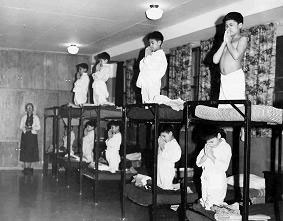
To a certain degree, the assimilation policies of the Canadian government amounted to cultural genocide. The residential schools severed any connection between the aboriginal families and their children, as contact with families was actively discouraged. Students as young as seven were forced to leave behind the familiar world in which they were raised, entering an entirely different environment consisting of “new culture, language and role expectations without any support whatsoever.”[13] This isolated environment made it easier for educators to “assimilate” aboriginal children into white society. Authority figures constantly extolled the virtues of Western society which “sought to reinforce the innate superiority” of white values.[14] At the same time, they denigrated all aspects of the aboriginal culture, even prohibiting children from speaking their ancestral language. Documentation shows educators reinforced this value hierarchy through punishments that ranged from beatings to sexual assault; in addition children were confined in dark closets and forced to remain kneeling for prolonged periods of time. [15],[16]
Punishment and indoctrination stripped the aboriginals of their cultural identity. The deeply entrenched shame that children felt towards their culture complicated relationships with their families. For example, when children returned to their parents they often refused to eat raw meat—a practice common in the aboriginal culture—claiming it was the basis of all illness affecting the Inuit people.[17] Such examples do not mean that assimilation was a success. A testament to the failure of the education process was the fact that in 1945, in a pool of approximately nine thousand aboriginal children, “only about 100 [were developmentally] beyond grade 8 and none [were] beyond grade 9.”[18] Students from residential schools were alienated from both the native and white-Canadian communities; many graduated without the necessary skills to operate within the aboriginal community or white Canadian society. For example, hunting skills, critical for survival in the Native community. were neglected at the schools; instead, children were trained in basic domestic work or manual labor.[19]
Legacy of the Residential School
Children also suffered negative effects from the abuse they encountered at the schools. Many students found it difficult to relate to others and were likely to resort to violence or redirect their anger towards loved ones.[20] Some former students of the residential schools directed their rage towards their children and spouses. For instance, a study by the Cariboo Tribe Council and the University of Guelph found that participants who had fathers that attended a residential school were more likely to report physical violence initiated by their father against their mother.[21] Many students later abused their children, thus continuing the cycle of violence. Survivors from the residential schools were poorly prepared to become parents, as they were raised in a rigid institution of authoritarianism.[22] Many report having trouble “showing affection to their children or us[ing] harsh discipline methods.”[23] Families in native communities continue to break down as former students are unable to creatively raise children or establish a healthy relationship with their spouses.
Children raised by former students of residential schools are found to be increasingly involved in criminal activity. A study by Aboriginal People’s Safety found that factors such as childhood disadvantage, deprivation, child abuse, parental drinking, and violence will often lead to youths’ victimization and “involvement in the criminal justice system.”[24] For instance, the correctional service system reported that although aboriginals only make up 2.5 percent of the Canadian population, they constitute almost 18 percent of those incarcerated in federal penitentiaries.[25] However, in the Western provinces, where a majority of the residential schools were located, aboriginals comprise an even greater proportion of those in prison. For example, in Manitoba and Saskatchewan, where aboriginal people make up 15 percent of the provincial population, they account for nearly 64 and 76 percent of provincial jail admissions respectively.[26] More importantly, nearly 98 percent of the residents from healing lodges, a federal program that offer services and programs to aboriginal offenders, have had at least one parent or grandparent in the residential schools.[27] The children of those placed in residential schools grow up in an environment plagued with abuse and neglect. Without parental guidance or a healthy upbringing, many aboriginals turn to substance abuse, compulsive gambling, and alcoholism.
The legacy of physical and sexual abuse has been the cornerstone of many social problems within the aboriginal community. Many of the punishments instituted by the teachers were explicitly sexual in nature, and would later lead to sexual problems in adulthood.[28] For example, sexual abuse and incest are prevalent in the aboriginal community today. A study sponsored by the Native Women’s Association of the Northwest Territories “found that eight out of ten girls under eight years of age were victims of sexual abuse, and five out of ten boys were also sexually abused” in aboriginal communities. Scholars trace the high rate of abuse to the legacy left behind of the residential schools.[29]
The lack of a support network for former survivors and their children has dramatically increased suicide rates among aboriginals. Many former attendees report symptoms of post-traumatic stress disorder, including blackouts, nightmares, depression, and apathy.[30] Depression is significantly higher in native communities, with the suicide rate 2.1 times higher than the non-indigenous Canadian rate; not only are former students affected by their experiences, but their children and the aboriginal community as a whole are severely impacted.[31] For instance, in 2000, suicide accounted for almost 22 percent of “all deaths among aboriginal youth (aged 10 to 19 years).”[32] The perceived lack of opportunity and systematic abuse from parents has led to this devastating and unfortunate consequence.
Furthermore, economic and educational opportunities continue to escape aboriginal youth. Their experiences in residential schools have led former students to develop a deep mistrust of Canadian institutions, including public schools.[33] Children of former students are discouraged from entering mainstream education; parents nurture a fear that their children will face similar traumatic experiences. Moreover, even when aboriginals enter public schools, they face prejudice and unhealthy stereotypes that hinder their ability to perform well; aboriginal students avoid school due to discrimination by peers and faculty, and it no surprise that the dropout rate in secondary schools is extremely high among aboriginal youth.[34]
Conclusion
Tragically, the negative effects of residential schools can never be undone; problems within the native community will take generations to solve. Racism and negative stereotypes shaped by the residential schools tint the Canadian perspective on aboriginals and contribute to native economic and social marginalization. However, the Canadian government is taking the correct approach with the compensation package that is currently being offered to the native population. Although money will never absolve the legacy of the residential schools, it is a step in the right direction. The government also instituted the Truth and Reconciliation Commission of Canada, which was founded to educate Canadian society on the systematic abuses that unfolded in residential schools and compile a complete historical record.[35] This foundation should serve to educate the future generations of Canada on the extraordinary abuses that occurred in the residential schools and help to dismiss aboriginal stereotypes and racial attacks. Hopefully, Canada can begin to closely examine a redress of the awful legacy left by the residential schools.
References for this article can be found here.