
Pumping Petroleum from Hardisty to Houston

- Protests over the United States’ potential endorsement of the Keystone XL Oil Pipeline have increased, springing the issue into national awareness.
- While environmentalists argue the dangerous consequences of destructive mining tactics, possible spills and accidents, and the invasiveness of a cross-country crude oil pipeline, pragmatists argue the pipeline’s economic and diplomatic advantages.
- The issue has now become mired in a swamp of politics, where the consequences of either support or rejection of the pipeline will be equally damaging to executive officials’ patronage from their constituents.
Demonstrations outside the White House in Washington, D.C. are not uncommon. However, if the average tourist visited the President’s residence between August 19 and September 2, he or she would have encountered especially vocal and defiant protesters. Residents of the United States and Canada gathered in opposition to the construction of the Keystone XL oil pipeline, a 1,700 mile-long petroleum transit line extending from Hardisty, Alberta to several gulf cities in Texas. Well over 500 protesters were arrested while committing acts of civil disobedience in an extremely visible show of discontent with Washington’s pipeline construction inclinations.[1] The protestors demanded that President Obama withhold his support for the project, citing the potential impact on mid-western states’ environmental welfare.
The U.S.-Canadian project has been touted as an act of trans-continental solidarity between longtime economic, political, and cultural allies. The Canadian energy company TransCanada proposed Keystone XL as a means to connect a unique form of “bituminous crude petroleum,” found in the “tar sands” of Alberta, with the multi-billion dollar Texan oil refinery business.[2] The recent uproar over the pipeline was further energized when the U.S. Department of State released a report that “reaffirmed the environmental integrity of the project.”[3] The report was released as Secretary of State Hillary Clinton prepared to make a final recommendation on the pipeline’s construction to President Obama, attracting the attention of both opponents and proponents of the pipeline.
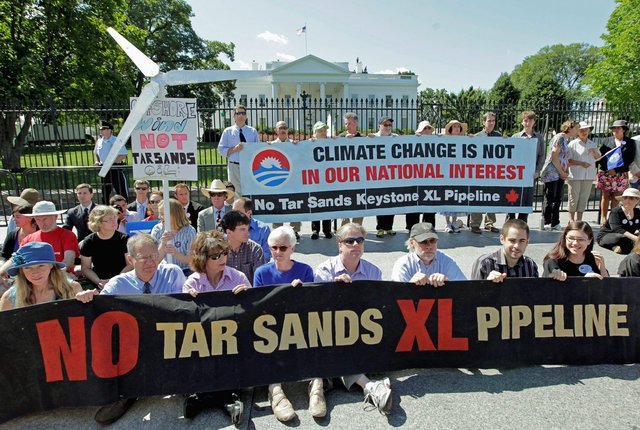
- Source: Associated Press
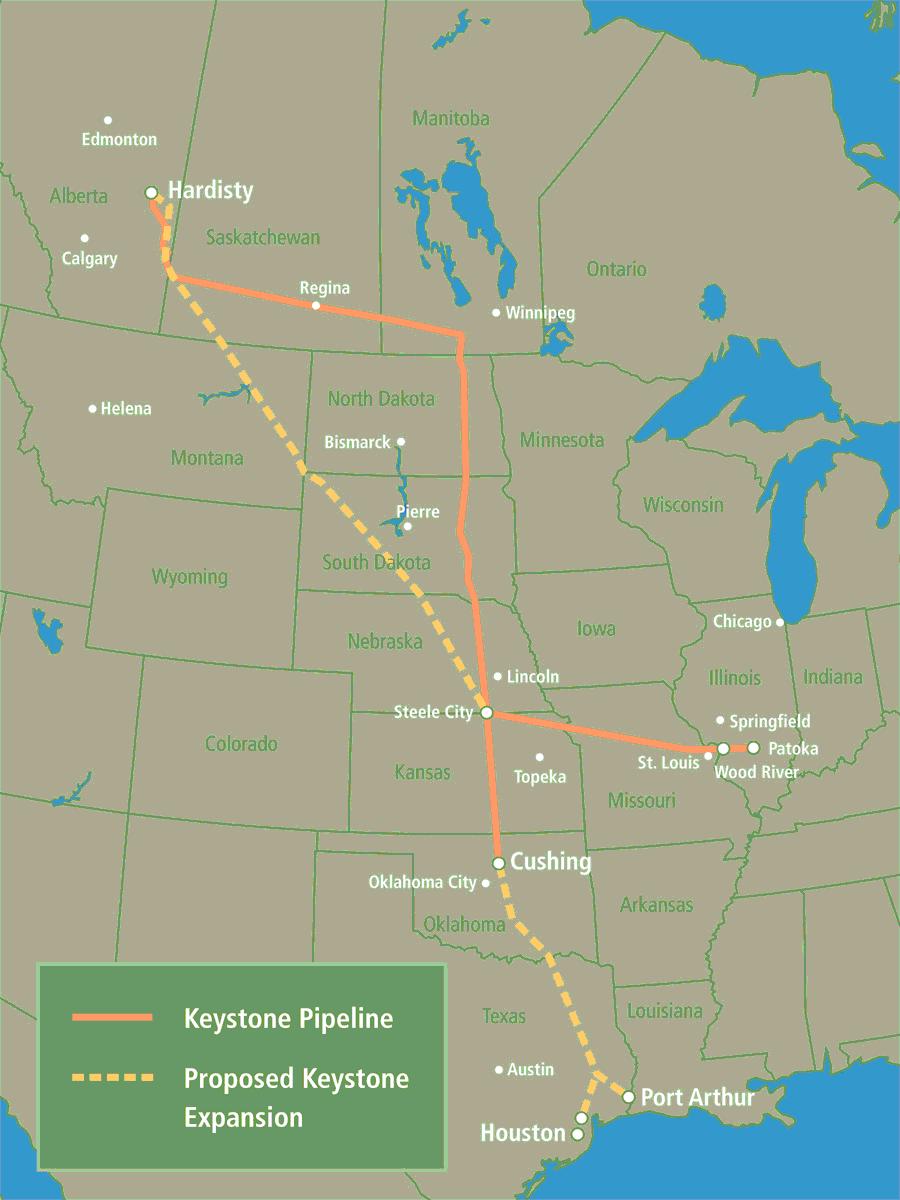
In June 2010, TransCanada began the first phases of construction and operation of the Keystone XL pipeline in Canada.[4] Keystone XL is an expansion of the already existing Keystone Pipeline, which runs east across Alberta, Saskatchewan, and Manitoba, south from North Dakota to Kansas, east through Missouri and then into Illinois.[5] The expanded petroleum route will extend through parts of Montana and continue south through Oklahoma and Texas.[6] The Keystone XL pipeline will cost USD 7 billion to construct and will carry nearly 800,000 barrels of oil a day into the U.S. from Canada.[7]
Though seemingly very different, Alberta and Texas share a similar economic reliance on petroleum. In a report earlier this year, The Economist discussed the production of oil in Alberta across a 232 square-mile area known as the tar sands or oil sands.[8] A crude form of petroleum called bitumen occurs naturally underground in this region, which is home to “one of the largest oil reserves in the world.”[9]
An Environmentalist’s Nightmare
Opposition to the project extends beyond the gates of the White House. Many U.S. citizens question the safety and necessity of the project. Environmentalists and alternative-fuel advocates insist that its approval indicates merely a “commitment to the petroleum-based economy.”[10] There are concerns about increased gas emissions from both the construction of the pipeline and the widespread use of the oil within the U.S. Many are concerned about the negative impact the Keystone XL project could have on ecosystems within Alberta, as well as the ecological damage potential spills and accidents could cause. [11]
Groups like the Sierra Club, a North American environmental preservation organization, claim the pipeline also endangers regions of the U. S. that would normally never be exposed to such incidents.[12] Jim Hansen of NASA stated that using tar sands, considered “unconventional energy sources” by scientists, would mean “essentially game over for the climate.”[13] The organizer of the White House protests, Bill McKibben, pointed out that while the U.S. government insists there are no environmental risks, the Canadian government, does foresee possible risks and has demanded that extensive environmental research and preparations be carried out in order to limit the potential environmental damage.[14] In 2009, the Canadian Parliament passed Directive 74, an initiative designed to minimize particle flow into bodies of water called “tailing ponds” created by the oil mining process.[15] Seven Canadian companies have formed a coalition to limit these ponds—all in an effort to make the bitumen-based oil “more politically and environmentally palatable.”[16]
Other concerns abound. The Center for American Progress is convinced that the “Keystone XL pipeline would be a step backward” in the fight for alternative energy.[17] The Washington Post reported that several Native American cultures and territories could be adversely affected.[18] In addition to posing cultural threats to indigenous people and their environments, the pipeline could cause more widespread, potentially critical environmental damage. After all, the original Keystone pipeline experienced twelve separate leaks during its first year of operation.[19] McKibben noted that the pipeline would run “over the Ogallala aquifer, the biggest source of freshwater in the middle of our continent,” a potentially devastating location for an oil leak.[20]
The Benefits of Oil
Despite the many concerns, economic interests and crude political motivations surrounding the pipeline may win the day. TransCanada has launched a sizeable marketing campaign to win over those hesitant about the idea of a Canadian pipeline running the vertical span of the U.S. The company’s Landowner Relations division emphasizes TransCanada’s recognition of the protestors’ environmental concerns:
We believe that through consultation with landowners, communities and other interested stakeholders, we can address questions and concerns and integrate important public input into our activities.[21]
David Goldwyn, former Envoy and Coordinator for International Energy Affairs for the State Department, reported that Secretary of State Clinton is eager to endorse the submitted plan.[22] Canadian Foreign Minister John Baird allegedly informed Clinton privately that the Keystone project was “tremendously important to the future prosperity of the Canadian economy.”[23]
A report published by The Economist stated that tar sands today account for nearly one and a half million barrels of oil produced every day, and by 2025 that number will rise to three and half million.[24] Even though 70 percent of the world’s oil is controlled and produced by OPEC countries, half of the remaining global oil supply comes from tar sands.[25] In other words, these “bituminous crudes” are here to stay.[26] So, the U.S. government is asking, why not get in on the action?
The same report projected that 173 billion barrels are available within the Alberta tar sands, valued at around USD 15.7 trillion.[27] If America were to reject the Keystone XL pipeline, other nations, especially those Asian countries that could be accessible via Canada’s western coast, would gobble up Alberta’s oil supplies.[28] Therefore, indicates Senior Fellow Robert Bryce of the Manhattan Institute, Keystone XL is an opportunity to preserve “cheap, abundant, reliable energy” within North America.[29] The U.S., according to Bryce, has experienced a fall in emissions as well as in energy usage over the past decade, while other countries like Vietnam have experienced huge increases in usage.[30]As Bryce sees it, we have an opportunity to responsibly and efficiently utilize the resources others might waste or misuse.[31] Bryce fails to acknowledge that while Vietnam’s usage has increased, its total carbon emissions will hardly rival the gargantuan levels emitted by the U.S. John Monaghan, a specialist for the Heartland Institute, echoed these concerns: “Failure to complete this project will cause greater harm to the environment at a greater cost…Billions of dollars of direct investment into the economy are at stake.”[32]
A Political Catch-22
The pipeline decision, regardless of protests and environmental concerns, unfortunately becomes one of politics. The State Department report asserted:
State officials concluded that although oil sands extraction is more carbon-intensive, the pipeline project would not affect Canadian production because companies there would simply ship their heavy crude through other forms of transportation if the pipeline didn’t exist.[33]
In other words, the net environmental damage of American usage and sponsorship of the pipeline is negligible simply because if we do not participate, Canada will send the oil elsewhere by other means that may be more environmentally detrimental. In addition, The Economist observed that both the U.S. government and the majority of U.S. citizens prefer Canadian oil to Middle Eastern or Venezuelan oil.[34] Essentially, Canada has cornered the U.S. into a situation where failure to invest in a large amount of “non-conflict oil” could, politically speaking, cripple an already struggling presidency.[35]
Clearly, the environmental damage is not a direct result of an executive oversight or a particular Washington agenda. In fact, the main environmental infringements extend from the oil company itself and the original project, passed with vigorous support from Canadian Prime Minister Stephen Harper.[36] Harper, a native of Alberta, has been called “friendly to ‘crude people.’”[37] It is clear that Canadian criticism of the project “has everything to do with the Prime Minister’s desire to protect the oil business and to avoid offending voters in Alberta, where his party has its core support.”[38]
The value of bituminous crude is undeniable, even if its true effects on the environment remain clouded. Regardless, the extraction of this crude is all but inevitable. President Obama must decide whether to give up USD 15.7 trillion of oil on principle due to its ecological impact, or to approve Keystone XL as a means of protecting domestic oil sources from foreign interests. Therefore, the decision to prevent extensive environmental damage does not reside in the Oval Office at all. If the protesters outside the White House want to protect biological stability and prevent pipeline construction, they should not visit 1600 Pennsylvania Avenue, but rather 80 Wellington Street – the Office of the Canadian Prime Minister – where environmental protection of the Alberta tar sands has quite effectively been dismissed.
References for this article can be found here.
Please accept this article as a free contribution from COHA, but if re-posting, please afford authorial and institutional attribution.
Exclusive rights can be negotiated.