How About a Modest Act of Decency to One Very Flawed Former Panamanian Dictator?

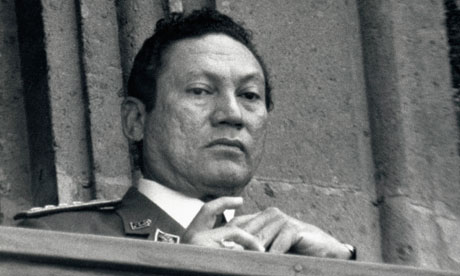
General Manuel Noriega’s return to Panama yesterday, after serving 22 years of imprisonment abroad, poses serious questions for the Panamanian system of justice, the rectitude of Washington’s treatment of Noriega during his long period of incarceration, and the future fate of the 77-year-old former dictator.
The Noriega case is surrounded by gross hypocrisy, a failure to tell the full truth concerning the nature of the U.S.-Panamanian relations during the period of Noriega’s rule of the country from 1983-1989, and the exact details of the ties existing at the time between Washington and Panama City.
At the Council on Hemispheric Affairs, we have long been intrigued by the links between the two hemispheric entities. From the days of Noriega’s attendance at the Peruvian National Academy as a young cadet—Panama did not have such an institution of its own—to shortly before the establishment of intelligence connections between the youthful Noriega and the colossus to the north, Noriega’s flawed relationship with Washington has been a matter of conjecture. What we had here was a cursed knot binding the two countries together.
It is probable that Noriega’s privileged place on the U.S. payroll would have lasted to this day if Roberto Eisenmann, a distinguished Panamanian democratic figure, had not fled to the country at the risk of his life after being identified as a mortal foe of the Panamanian strongman. Eisenmann tirelessly patrolled the corridors of power in Washington, spreading anti-Noriega gospel. Finally, through much of the 1980s, Eisenmann lobbied the U.S. Senate until he was successful in having that body pass a resolution cutting off all assistance to Panama because of Noriega’s human rights violations and his connections to drug-trafficking and money laundering.
But President George H.W. Bush did not readily acquiesce to the anti-Noriega template being pushed at this point by the Senate. Noriega had been an effective CIA asset, plying Washington with accurate on-the-ground information in the Washington-backed contra campaign against the Sandinistas and in the Salvadoran government’s ugly war against the FMLN guerrillas.
Noriega had allowed U.S. airplanes to take off from Howard Air Force Base to fly over Nicaragua and El Salvador to photograph and select potential targets for U.S.-backed local forces, as well as critical intelligence information on Cuba and on Russian activity in the Caribbean basin. On a visit to Panama in the 1980s, Bush was reportedly briefed on local realities. When Bush became president and the Senate was taking a strong embargo stand against Noriega, the U.S. president eventually yielded to the interventionists in Washington who were calling for military action against Panama. Even though Bush would have preferred to have tried to maintain the formerly valuable U.S. ties with Noriega, this had become all but impossible. This was particularly the case after the late Senator Ted Kennedy and other Senate liberals like Senators Dodd and Leahy were calling for decisive actions against the cynical Panamanian dictator.
(COHA director Larry Birns had been invited to Panama by General Noriega just before the U.S. invasion was launched. In his communiqué to Birns, he described him as his “honorable enemy.” Birns is believed to have been the last American citizen to meet with Noriega before the U.S. attack was launched.)
So what to do with General Noriega now that he is arriving back to his country after having served more than 22 years in U.S. and French jails? It would clearly be cruel and unusual punishment to be sent to some bleak Panamanian jail at the age of 77, no matter how accented by interior decoration. In keeping with Panamanian law, the international community should call upon Panamanian authorities to place the Panamanian outcast under nothing more than house arrest, rather than requiring him to face another 20 years of incarceration or even more.
The U.S. knowingly and cynically used Noriega even though it was fully apprised regarding his links to drug traffickers and money launderers. Incidentally, Noriega, while being portrayed back in Washington as a large-scale drug trafficker, was actually a relatively modest operator. And the U.S. falsely told the American people that the elimination of Noriega would all but end the drug trafficking surge, a notion which was and is patently untrue.
Today, under president Ricardo Martinelli, Panama is even more corrupt than it was under Noriega, yet President Obama did not even bother to mention this fact when he aggressively campaigned for the passage of the bilateral trade agreement with that country.
COHA calls for compassion. House arrest is the proper sentence to mete out to a man who was but one of countless U.S. officials and Central American operators who worked outside the law and would never qualify for a red badge of courage.